

From compliance-led adoption to commercial flexibility and better outcomes.
The Procurement Act 2023 came into force on the 24th February 2025, introducing a simpler and more flexible procurement regime designed to improve transparency, competition, public benefit and value for money. For the railway industry, it presents a real opportunity to rethink how procurement is approached.
However, rail procurement has its own set of challenges. Complex technical requirements, ageing assets, component compatibility and a relatively constrained supplier market means that a standard, one-size-fits-all approach will not always deliver the best outcome. Buyers need to be able to adapt their approach to the requirement, the market and the risks involved.
From our experience here at Enigma Seven, adoption across the railway has been cautious. Train operating companies and other rail buyers are adapting to the new regime, but we believe there is still more to be gained from the flexibility the Act provides. Competitive flexible procedures can remain conservative in their design, open frameworks are not yet widely used, and preliminary market engagement can sometimes focus on the process itself rather than resolving the issue.
We see the Procurement Act as more than just a regulatory change. If used well, it can be a practical commercial enabler, helping buyers develop stronger specifications, encourage wider supply-chain participation, manage technical and compatibility risks, and create more resilient routes to market for recurring maintenance, overhaul and component requirements. The opportunity now is to move beyond simply complying with the Act and start making more deliberate use of the options available.
Understanding the realities of rail procurement
Rail procurement operates in a particularly demanding and complex environment. Buyers are responsible for maintaining safety-critical assets over long operational lives, often whilst dealing with ageing equipment, obsolescence, component compatibility, limited technical alternatives and a relatively concentrated supplier base.
Fleet components may need repeated overhaul, repair or replacement. At the same time, operational continuity leaves little room for supply failure, delayed mobilisation or an unsuitable technical solution. The consequences of getting a procurement wrong can extend well beyond the contract itself.
Although these conditions do not naturally lend themselves to rigid competitions where every detail has to be settled at the outset. Requirements can still develop as technical evidence emerges. Different suppliers may offer alternative solutions or hold different intellectual property and the most appropriate commercial model may not be immediately obvious. In these circumstances, buyers need room to have structured conversations, refine requirements in stages and test whether proposed solutions are deliverable.
We believe that flexibility must sit alongside fairness, transparency and appropriate governance. Even though these principles are already in place, it doesn’t mean every procurement needs to follow the same approach.
The Procurement Act provides tools that can help buyers take a more tailored approach. The competitive flexible procedure can be designed around the requirement and the market. Open frameworks can allow new suppliers to join at defined points. Dynamic markets can support repeat purchasing from qualified providers, whilst preliminary market engagement gives buyers an opportunity to understand the market before committing to a particular procurement strategy.
Which leads me onto the fact that the challenge is not simply knowing that these options exist, but understanding when and how to use them to address the realities of rail procurement.
Are we making the most of the flexibility available?
From what we have seen at Enigma Seven, the railway has been slow to move beyond compliance-led implementation. New terminology and notices are being adopted, but established procurement behaviours can remain largely unchanged.
In practice, there is a risk of taking a familiar, linear procurement process and applying the new legal framework to it, rather than stepping back and asking whether the competition itself should be designed differently.
This is particularly relevant to the competitive flexible procedure. One of the benefits of the procedure is the opportunity to design a process that reflects the complexity of the requirement. Depending on what is being procured, that might involve dialogue, negotiation, multiple stages, solution development or progressive shortlisting.
However, a flexible procedure does not automatically produce a flexible procurement. If it is designed in much the same way as a traditional tender exercise, buyers can miss opportunities to challenge assumptions, improve deliverability and give suppliers the chance to propose alternative technical or commercial solutions.
Alongside this, we also see an opportunity to make greater use of open frameworks in the rail market.
Traditional closed arrangements can limit access to a market for several years. That may become restrictive when technology develops, asset conditions change or new suppliers build the capability to deliver. An open framework can provide a more adaptable route, preserving opportunities for competition and allowing capable SMEs or specialist suppliers to join at defined points during the framework term.
More broadly, the procurement route should reflect what the buyer needs to achieve, rather than being selected simply because it is familiar. There is no need to introduce complexity for its own sake. But where a requirement is technically uncertain, the supply chain is changing or demand is recurring, it is worth considering whether a more flexible approach could produce a better result.
Why speaking to the market matters
Preliminary market engagement is particularly important in rail because buyers cannot always assume that their internal knowledge provides a complete picture of current supplier capability, available capacity or emerging innovation.
Before finalising a procurement strategy, it is worth understanding what the market can realistically deliver and what might prevent suppliers from participating. That means looking beyond whether a supplier is interested in the opportunity and exploring the practical conditions needed for a credible bid.
Can the proposed scope be delivered as written? Are compatibility requirements justified? How should the requirement be packaged? What lead times, technical data, demand forecasts, volumes and commercial terms would suppliers need to price the work properly? These are the kinds of questions that can make a material difference to the quality of the competition.
Preliminary market engagement notices are becoming more visible, but a notice alone does not resolve a market problem. If the engagement is too generic, it may confirm that suppliers have been consulted without revealing much about the barriers they face.
At Enigma Seven, we believe the value lies in asking targeted questions and also using the answers to shape the procurement. Engagement should help buyers test their assumptions, understand the available options and make better-informed decisions before the tender documents are finalised.
The questions worth asking
A useful market engagement exercise should explore the following:
● Which technical, assurance or compatibility requirements genuinely constrain participation?
● Could the requirement be divided into lots without creating unacceptable integration risk?
● Are qualification requirements, insurance levels or financial thresholds proportionate?
● What technical data, fleet information and demand forecasts are needed for suppliers to price risk?
● Would dialogue, negotiation, demonstrations or proof-of-concept stages improve the outcome?
● What prevents SMEs and specialist suppliers from bidding directly or through the wider supply chain?
● Could an open framework or dynamic market support recurring requirements more effectively?
The important part after asking these questions is what happens next. Market feedback should be traceable through to the procurement strategy and tender documents. The scope, procedure, lotting strategy, participation conditions, evaluation method, timetable and contract should reflect what the buyer has learned. Where feedback is not adopted, there should be a clear rationale for that decision.
This creates a stronger connection between engagement and the decisions that follow. It also helps buyers demonstrate that consultation has informed their approach, rather than being a separate exercise carried out simply to meet a procedural expectation.
Turning the Act into a railway benefit
For us, the real opportunity is not simply to use the Procurement Act to replace one incumbent with another through an otherwise unchanged process. It is to create better market structures and more resilient commercial outcomes.
That starts with matching the procurement approach to the specific technical, operational and supply-chain characteristics of the requirement:
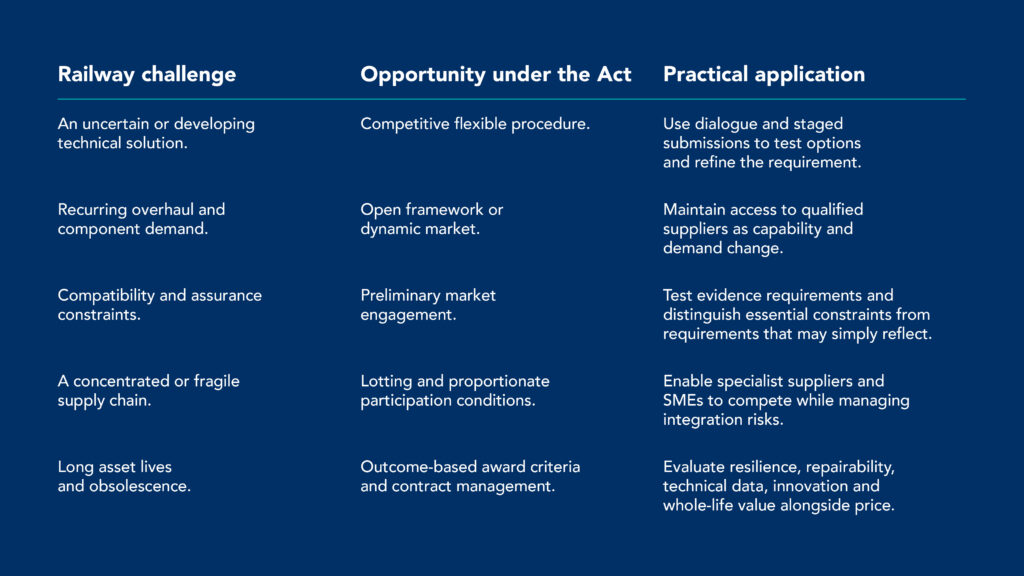
Where should rail organisations focus their efforts?
There is no single approach that will suit every procurement. However, we see several practical steps that could help rail organisations make better use of the Act:
- Make flexibility a design decision. Require every procurement strategy to explain how the chosen procedure reflects technical uncertainty, market structure and operational risk.
- Use preliminary market engagement to solve defined questions. Replace generic engagement with evidence-led testing of barriers, packaging, data, capacity and commercial assumptions.
- Expand the use of dialogue and staged competition. Use the competitive flexible procedure where requirements cannot be optimised through a single written tender.
- Develop open commercial routes. Identify recurring categories suited to open frameworks or dynamic markets, with transparent entry and refresh arrangements.
- Design for SMEs and specialist suppliers. Review lotting, turnover thresholds, insurance, bid burden and contracting models so that requirements are proportionate.
- Procure for whole-life outcomes. Evaluate reliability, maintainability, obsolescence management, technical data, resilience and customer impact alongside price.
- Strengthen the link between procurement and contract management. Carry promises made during market engagement and evaluation into measurable obligations, governance and performance reviews.
Moving from compliance to confidence
The Procurement Act gives the railway an opportunity to procure in a way that better reflects the realities of its assets, operations and supply markets. Its value will not be realised through new notices and terminology alone. It depends on buyers using the available flexibility with confidence, supported by sound commercial judgement, clear governance and meaningful engagement with suppliers.
From our perspective at Enigma Seven, the next step is to move from cautious adoption to purposeful use. Competitive flexible procedures, open frameworks, dynamic markets and targeted preliminary market engagement should be practical tools for managing complexity, rather than approaches considered only in exceptional circumstances. If used thoughtfully, they can help improve competition, reduce avoidable barriers, encourage innovation and create more resilient long-term outcomes for railway operators, suppliers and passengers.
Ultimately, good procurement is not just about getting the process right. It is about understanding the problem, choosing an approach that fits and putting the conditions in place for the contract to deliver lasting value. That is where we believe the real opportunity lies in using the flexibility of the Procurement Act not simply to meet compliance requirements, but to make better commercial decisions for the railway.
